Gleason Legal PLLCGleason Legal PLLC2026-06-03T09:19:55Zhttps://www.glnh.law/feed/atom/WordPress/wp-content/uploads/sites/1201474/2023/06/cropped-BAB_FAV11-new-32x32.jpgOn Behalf of Gleason Legal<![CDATA[New Hampshire Supreme Court Redefines Adultery]]>https://www.glnh.law/?p=462452021-04-12T09:08:02Z2021-04-01T04:00:00ZIn the Matter of Molly Blaisdell and Robert Blaisdell, the Respondent appealed the dismissal of a cross-petition for divorce on the grounds of adultery. That cross petition alleged that the Petitioner, Molly Blaisdell, was involved in an ongoing intimate relationship with another woman.
Prior to this decision, the definition of adultery in the State of New Hampshire was governed by In the Matter of Blanchflower and Blanchflower, 150 N.H. 226, 227-28 (2003). That decision limited the definition of adultery under R.S.A. 458:7, II (2018), to vaginal penetration by a penis “between a married man and someone other than his wife, or between a married woman and someone other than her husband.” Blanchflower suggested that case law addressing adultery inferred that adultery meant intercourse.
The New Hampshire Supreme Court notes that since that decision in 2003, there have been numerous changes to the law both in the State of New Hampshire and by way of United States Supreme Court decision. The question presented in this case, therefore, was whether Blanchflower should be overruled given the world we live in today.
The New Hampshire Supreme Court noted that they will overrule a decision only after considering “(1) whether the rule has proven to be intolerable simply by defining practical workability; (2) whether the rule is subject to a kind of reliance that would lend a special hardship to the consequence of overruling; (3) whether related principles of law have so far developed as to have left the old rule no more than a remnant of abandoned doctrine; and (4) whether facts have so changed, or come to be seen so differently, as to have robbed the old rule of significant application or justification.” Seacoast Newspapers v. City of Portsmouth, 173 N.H. 325, 333 (2020).
Though the New Hampshire Supreme Court found that no single factor was dispositive, they concluded that three factors (1, 3, and 4) weighed in favor of overruling Blanchflower. Perhaps more important than the first half of the decision, the New Hampshire Supreme Court then issued a re-interpretation of RSA 458:7, II. “In matters of statutory interpretation, [the New Hampshire Supreme Court is] the final arbiter of the intent of the legislature as expressed in the words of the statute considered as a whole.” Petition of Carrier, 165 N.H. 719, 721 (2013).
The Court then went through a review and analysis of the existing statutory construction and definitions governing both adultery and intercourse in light of the Respondent’s point that the Court does “not construe statutes in isolation; instead, we attempt to do so in harmony with the overall statutory scheme.” Estate of Gordon-Couture v. Brown, 152 N.H. 265, 272 (2005). The Court further agreed with Respondent’s argument “that defining the term adultery to include sexual intercourse between persons of the same sex would harmonize RSA 458:7, II and RSA 457:1-a, both of which are part of the legislative scheme governing marriage,” and to do the opposite “would be to interpret those two statutes in contradiction with each other in contravention of our rules of statutory interpretation.”
The Court further stated that “interpreting RSA 458:7, II to provide that spousal infidelity may be a ground for divorce only in marriage between persons of the opposite sex is constitutionally suspect in light of the United States Supreme Court’s holding in” Obergefell v. Hodges, 135 S.Ct. 2584, 2607-08 (2015), and that a “broader definition is better suited to today’s marital legal landscape.” Therefore, the New Hampshire Supreme Court redefined adultery under RSA 458:7, II “as voluntary sexual intercourse between a married person and someone other than that person’s spouse regardless of the sex or gender of either person. Furthermore, the New Hampshire Supreme Court redefined sexual intercourse to include “heterosexual intercourse involving penetration of the vagina by the penis, and intercourse involving genital contact other than the penetration of the vagina by the penis.”
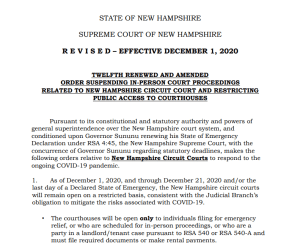
With this decision, the New Hampshire Supreme Court in no uncertain terms leaps forward to allow the law of this state to finally comport with 21st century realities of marriage and coupledom.]]>On Behalf of Gleason Legal<![CDATA[Divorce in the Time of COVID. Will My Case Ever Be Heard?]]>https://www.glnh.law/?p=462462021-04-12T09:08:07Z2020-11-27T05:00:00ZTwelfth Renewed and Amended Emergency Orders since the COVID pandemic took hold.
Those orders run through December 21, 2020, and/or the last date of the declared State of Emergency in New Hampshire (which will likely run at least through the Spring of 2021). Courts remain open on a very restricted basis during this time. The Superior and Circuit Courts are operating under similar orders for the foreseeable future.
What does this mean for your divorce in the time
of COVID, particularly when divorce filings appear to be on the rise, due in part to couples being confined together without reprieve? Will your case ever be heard in a timely manner?
Those proceedings related to temporary hearings in divorce and parenting cases, requests for relief as to domestic violence, child-related emergency orders, placement of a juvenile, injunctive relief, emergency mental health orders, proceedings directly related to the COVID pandemic, or those proceedings deemed to be in-person by the presiding judge may be held in person. Otherwise, hearings, status conferences and even trials are being conducted by way of telephonic and video platform hearings (the courts are currently using WebEx as a platform for video conferencing).
Though some courts have experienced significant delays in scheduling due to the COVID-19 pandemic, others have not. In many cases, access to the judiciary by way of telephonic and video platforms have enabled swifter and more economical access to justice. Prior to COVID, travel to and from a Court for a simple 30-minute scheduling conference could have meant hours of time amongst travel. Those significant wait times as other cases ran over, and other unanticipated delays, created numerous problems for litigants. With the onset of video conferencing and telephonic hearings, many of those previously extended court appearances have been significantly streamlined.
In the event of substantial delays on the part of the court, both private and court-appointed mediators have made themselves available to conduct mediations over ZOOM, telephone and via other video conferencing platforms. Access to justice, in large part, has not been negatively impacted in the realm of family law. No one knows what the future holds, but the ability of the judicial system to adapt to a pandemic and to embrace, in some instances, never before seen technology, has enabled most to continue to gain timely relief and access to justice.
Want to learn more? Contact us.]]>On Behalf of Gleason Legal<![CDATA[‘Ask Me Anything’ Gender Equality Panel a Success]]>https://www.glnh.law/?p=462482022-09-12T10:55:17Z2020-11-21T05:00:00ZOn Behalf of Gleason Legal<![CDATA[Social Distancing, Parenting Orders and Mediation as a Tool]]>https://www.glnh.law/?p=462502021-04-12T09:08:14Z2020-11-18T05:00:00Zstripped a mother (an emergency room doctor) of custody of her daughter as a result of the inherent risk factors associated with her employment.
In New Hampshire, the Courts have been reluctant to disturb parenting plans and remove children from the care of a parent, even where one parent is interacting with the public. What does this mean for parenting plans where one parent is concerned about exposure?
Most parenting plans under the statutory form encourage mediation as a way of resolving disputes prior to involving the Courts. Use of an experienced mediator can often bridge the gap between two parties at odds and a solution that often lies in the middle. One of the advantages of mediation is that parties can agree upon safeguards that are acceptable to them in order to limit exposure and prevent transmission. Not every mediation is successful, but with mediators available by telephone and ZOOM, it often makes sense to lean into a neutral third party to assist in crafting creative solutions acceptable to both parents.]]>On Behalf of Gleason Legal<![CDATA[Will There Be More Aid for Small Businesses In This Second Wave?]]>https://www.glnh.law/?p=462522025-04-30T14:52:34Z2020-11-11T05:00:00Z I’m as proud of many of the things
we haven’t done as the things we have done.
EMMA DOE, Company CEO
Quisque mattis, ligula id sodales ullamcorper, urna sem placerat lacus, id laoreet lectus sapien quis nisl. Phasellus eu massa id leo consectetur vehicula. Donec quis finibus lacus, id accumsan magna. Etiam ullamcorper id quam vitae iaculis.
Federal Aid Programs
Your criminal defense attorney may be able to negotiate your sentence to prevent you from winding back in court house. Nulla eu magna vel metus rutrum ullamcorper.
Quisque aliquet nibh sit amet lectus auctor
Nulla at metus ultricies, placerat augue sed.
Curabitur mollis ex vestibulum, ullamcorper.
Ut elit leo, condimentum consectetur
State Aid Programs and Unallocated Funds
In England, the usual division of labor is that a solicitor will obtain the facts of the case from the client and then brief a barrister (usually in writing). The barrister then researches and drafts the necessary court pleadings (which will be filed and served by the solicitor) and orally argues the case.In Spain, the procurator merely signs and presents the papers to the court, but it is the advocate who drafts the papers and argues the case.In some countries, like Japan, a scrivener or clerk may fill out court forms and draft simple papers for lay persons who cannot afford or do not need attorneys, and advise them on how to manage and argue their own cases.]]>On Behalf of Gleason Legal<![CDATA[Complex Asset Divorce and The Importance of Skilled Representation]]>https://www.glnh.law/?p=462532022-09-12T11:02:36Z2020-11-10T05:00:00ZI’m as proud of many of the things we haven’t done as the things we have done.
EMMA DOE, Company CEO
Quisque mattis, ligula id sodales ullamcorper, urna sem placerat lacus, id laoreet lectus sapien quis nisl. Phasellus eu massa id leo consectetur vehicula. Donec quis finibus lacus, id accumsan magna. Etiam ullamcorper id quam vitae iaculis.
Corporate Law Firms
Your criminal defense attorney may be able to negotiate your sentence to prevent you from winding back in court house. Nulla eu magna vel metus rutrum ullamcorper.
Quisque aliquet nibh sit amet lectus auctor
Nulla at metus ultricies, placerat augue sed.
Curabitur mollis ex vestibulum, ullamcorper.
Ut elit leo, condimentum consectetur
Leading private equity firms
In England, the usual division of labor is that a solicitor will obtain the facts of the case from the client and then brief a barrister (usually in writing). The barrister then researches and drafts the necessary court pleadings (which will be filed and served by the solicitor) and orally argues the case.In Spain, the procurator merely signs and presents the papers to the court, but it is the advocate who drafts the papers and argues the case.In some countries, like Japan, a scrivener or clerk may fill out court forms and draft simple papers for lay persons who cannot afford or do not need attorneys, and advise them on how to manage and argue their own cases.]]>
 What does this mean for your divorce in the time
of COVID, particularly when divorce filings appear to be on the rise, due in part to couples being confined together without reprieve? Will your case ever be heard in a timely manner?
Those proceedings related to temporary hearings in divorce and parenting cases, requests for relief as to domestic violence, child-related emergency orders, placement of a juvenile, injunctive relief, emergency mental health orders, proceedings directly related to the COVID pandemic, or those proceedings deemed to be in-person by the presiding judge may be held in person. Otherwise, hearings, status conferences and even trials are being conducted by way of telephonic and video platform hearings (the courts are currently using WebEx as a platform for video conferencing).
Though some courts have experienced significant delays in scheduling due to the COVID-19 pandemic, others have not. In many cases, access to the judiciary by way of telephonic and video platforms have enabled swifter and more economical access to justice. Prior to COVID, travel to and from a Court for a simple 30-minute scheduling conference could have meant hours of time amongst travel. Those significant wait times as other cases ran over, and other unanticipated delays, created numerous problems for litigants. With the onset of video conferencing and telephonic hearings, many of those previously extended court appearances have been significantly streamlined.
In the event of substantial delays on the part of the court, both private and court-appointed mediators have made themselves available to conduct mediations over ZOOM, telephone and via other video conferencing platforms. Access to justice, in large part, has not been negatively impacted in the realm of family law. No one knows what the future holds, but the ability of the judicial system to adapt to a pandemic and to embrace, in some instances, never before seen technology, has enabled most to continue to gain timely relief and access to justice.
Want to learn more? Contact us.]]>
What does this mean for your divorce in the time
of COVID, particularly when divorce filings appear to be on the rise, due in part to couples being confined together without reprieve? Will your case ever be heard in a timely manner?
Those proceedings related to temporary hearings in divorce and parenting cases, requests for relief as to domestic violence, child-related emergency orders, placement of a juvenile, injunctive relief, emergency mental health orders, proceedings directly related to the COVID pandemic, or those proceedings deemed to be in-person by the presiding judge may be held in person. Otherwise, hearings, status conferences and even trials are being conducted by way of telephonic and video platform hearings (the courts are currently using WebEx as a platform for video conferencing).
Though some courts have experienced significant delays in scheduling due to the COVID-19 pandemic, others have not. In many cases, access to the judiciary by way of telephonic and video platforms have enabled swifter and more economical access to justice. Prior to COVID, travel to and from a Court for a simple 30-minute scheduling conference could have meant hours of time amongst travel. Those significant wait times as other cases ran over, and other unanticipated delays, created numerous problems for litigants. With the onset of video conferencing and telephonic hearings, many of those previously extended court appearances have been significantly streamlined.
In the event of substantial delays on the part of the court, both private and court-appointed mediators have made themselves available to conduct mediations over ZOOM, telephone and via other video conferencing platforms. Access to justice, in large part, has not been negatively impacted in the realm of family law. No one knows what the future holds, but the ability of the judicial system to adapt to a pandemic and to embrace, in some instances, never before seen technology, has enabled most to continue to gain timely relief and access to justice.
Want to learn more? Contact us.]]> Your criminal defense attorney may be able to negotiate your sentence to prevent you from winding back in court house. Nulla eu magna vel metus rutrum ullamcorper.